
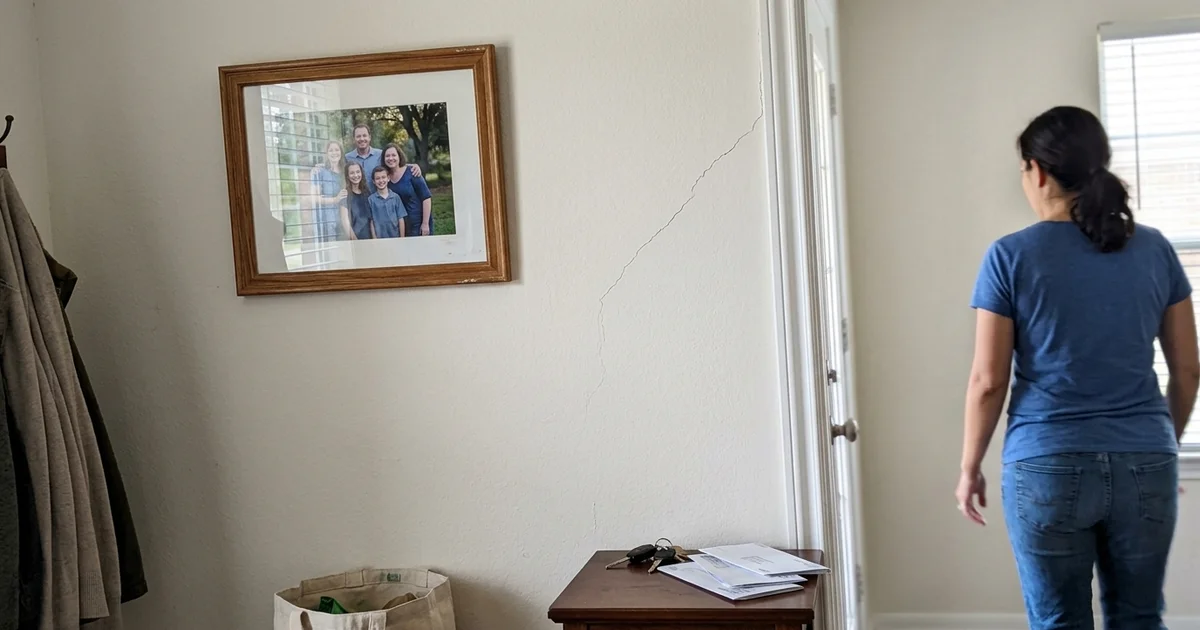
A freshly painted Round Rock wall suddenly shows a jagged line right above the doorframe. Why does drywall crack?
Round Rock sits on expansive Blackland clay, and the ground beneath us dictates what happens to the walls around us. Austin-area boom-and-bust rainfall causes significant soil movement.
Understanding the root cause helps you decide whether you need drywall crack repair, a structural check or both.
Expansive Clay Soils
Round Rock drywall cracks trace back to Blackland Prairie clay, specifically “Houston Black” Vertisol common across the city. Texas A&M AgriLife notes this soil can swell and shrink by up to 35 percent depending on moisture.
After a hot, dry Round Rock summer, the ground visibly pulls away from concrete slabs. Heavy rains then flood the area, causing the soil to swell back with tremendous force.
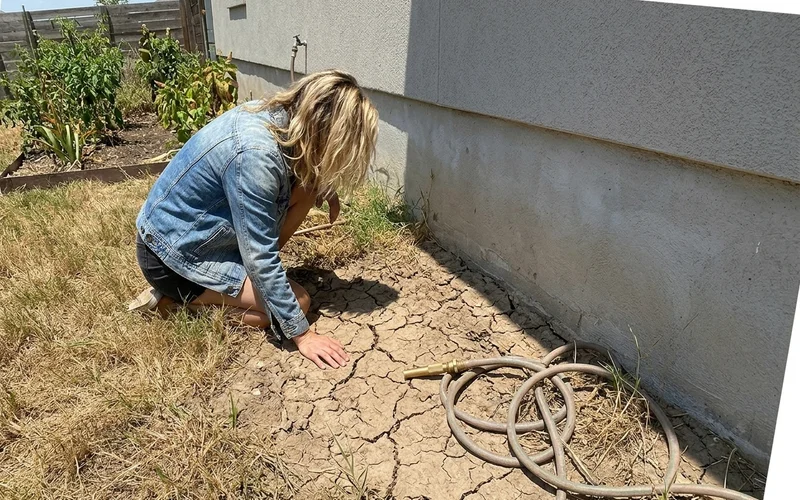
That cycle moves Round Rock foundations slightly, season after season.
Other Common Causes in Round Rock Homes
- New construction settling. Lumber in Paloma Lake and Siena new builds dries and shrinks 2 to 7 percent across the grain in the first two years. This pops nails and snaps taped seams.
- Temperature and humidity swings. Round Rock summer heat creates thermal expansion in unvented attics that stresses ceiling joints.
- Poor taping. Fast-track Round Rock builds sometimes have under-reinforced corners.
- Roof and truss movement. Trusses flex with Round Rock temperature changes.
- Water damage. A single slab leak dumps 10,000 gallons into Round Rock clay yearly, accelerating foundation shift.
Where Round Rock Cracks Usually Show Up
| Location | Common cause | Structural Indicator |
|---|---|---|
| 45-degree diagonal from door corners | Foundation or framing movement | Racking frames |
| Along tape joints on flat walls | Movement plus weak taping | Often cosmetic |
| Ceiling joints running parallel | Truss movement, settling | Lumber shrinkage |
| Where walls meet ceilings | Truss uplift, seasonal movement | Attic temperature swings |
| Around nail heads (Nail pops) | Framing shrinkage | Normal drying |
Cosmetic or Structural?
The International Association of Certified Home Inspectors flags any separation wider than 1/8 inch as a potential warning sign. Most Round Rock hairline fractures under 1/16 inch are cosmetic shrinkage.
Call a structural engineer first if you see:
- Gaps wider than 1/8 inch or steadily widening.
- Stair-step patterns in exterior Round Rock brick.
- Doors or windows that stick.
- Sloping floors or gaps between floors and baseboards.
- Repairs that fail rapidly after a fresh patch.
- Several new fissures appearing simultaneously.
Our Round Rock promise
If a crack looks like a sign of structural movement, we will tell you before covering it up.
Round Rock Repairs That Last Longer
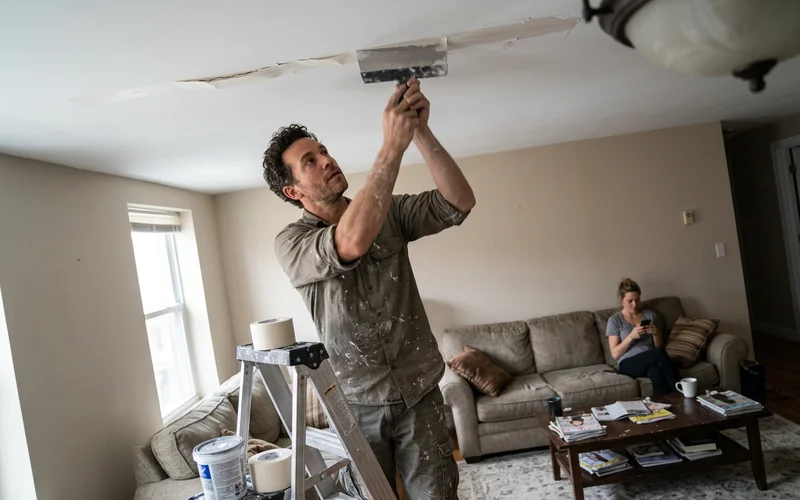
- Open the crack slightly with a utility knife and remove loose material.
- Embed tape firmly. USG testing shows paper outperforms fiberglass mesh in shear strength during active movement.
- Apply joint compound in three thin coats, feathering each wider than the previous.
- Sand smooth to match the surrounding texture.
- Prime and paint the full wall corner to corner.
See texture matching for making the patch invisible.
Can You Stop Round Rock Cracks From Coming Back?
- Install a soaker hose system about 18 inches away from your slab during Round Rock drought conditions.
- Route all gutter downspouts at least five feet away from the perimeter.
In active Round Rock clay soils, occasional hairline fractures may still return over several years even after a quality repair.
Seasonal Patterns in Round Rock
The transition from scorching Round Rock summer to wet autumn triggers the most aggressive soil shifts. We get a surge of repair calls in late September when the first heavy rains hit the parched ground.
The 2011 Texas drought established a baseline for how extended heat permanently alters Blackland clay compaction. Separations that grow steadily regardless of season are a red flag.
Ceiling Cracks at Interior Walls
A distinct split where ceiling meets an interior wall is typically caused by roof truss uplift. The bottom chord of the truss shrinks while the top chord expands with Round Rock attic moisture.
We fix this by “floating” the drywall corners, removing screws within 16 inches of the wall so the ceiling flexes without snapping the joint.
Keep a Record
Take a dated photo of damaged areas with a ruler. Check the width again in 60 days to see if the movement is active or historical. Use digital calipers near the 1/8-inch threshold.
Cracks in Newer Round Rock Homes
Lumber in new Paloma Lake and Siena homes requires up to two full years to reach equilibrium with Round Rock indoor environment. Many Round Rock builders offer a one-time touch-up at 11 months.
Exterior Round Rock Clues to Check
Walk the exterior perimeter aligned with interior damage. Look for stair-step separations in brick mortar wider than 1/4 inch. Inspect frieze boards pulling away from siding or uneven gaps around window frames.
Get It Looked At
Our Bluebonnet Ridge Painting Round Rock team offers free Round Rock estimates. Our estimators clearly explain what’s cosmetic and what might require an engineer’s input.
Call (512) 555-0163 or email demo@locuspilot.com to schedule your Round Rock walkthrough within 24 hours anywhere in Williamson County.