
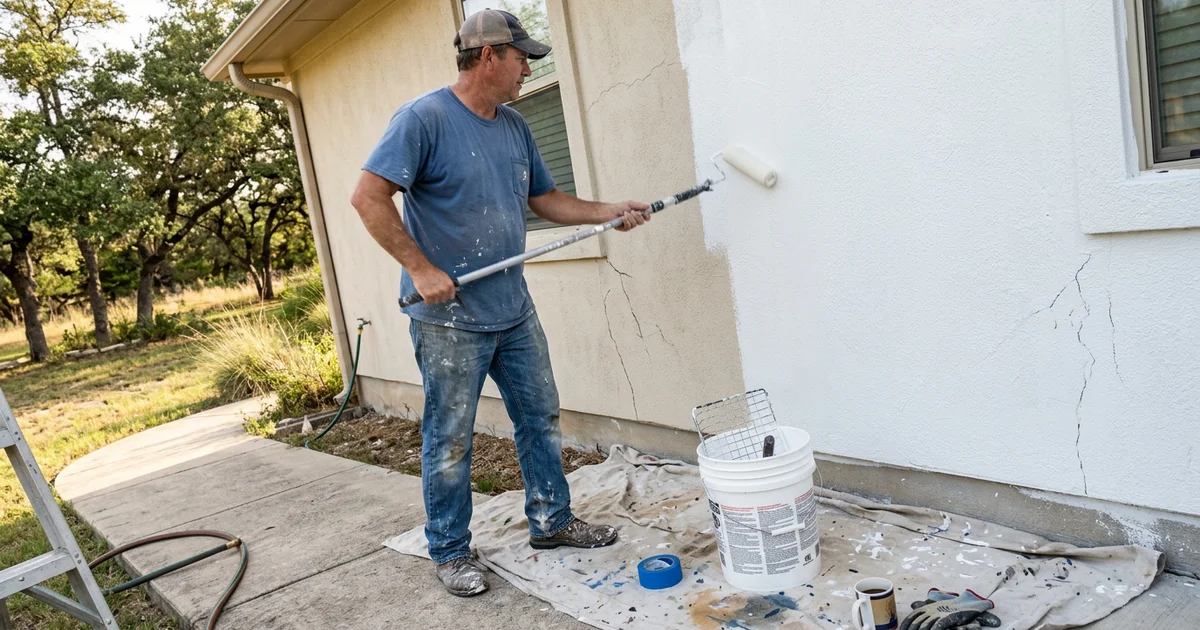
Dealing with exterior stucco in Round Rock often feels like a constant battle against hairline cracks.
The Round Rock climate pushes stucco hard. Summer afternoons routinely top 96 degrees, and the Blackland Prairie clay soil swells with spring rain and shrinks in dry summer heat. That seasonal movement opens hairline fissures across the Tuscan-style stucco in Siena, the custom estates of Behrens Ranch and the stucco accents on homes across Forest Creek.
We see this exact issue on almost every Round Rock stucco job. Here’s a scenario-based look at when elastomeric paint for stucco earns its premium cost, and when a standard acrylic is smarter. For how we approach stucco painting in Round Rock, see our service page.
What Is Elastomeric Paint for Stucco?
An elastomeric coating is a specialized, high-build exterior paint designed to stretch and recover like a rubber membrane. Standard acrylic exterior paint goes on at roughly 2 to 3 mils thick.
Elastomeric products like Sherwin-Williams ConFlex XL or Behr PREMIUM Elastomeric apply at a massive 10 to 20 mils per coat. The material can stretch up to 300 percent of its original size without tearing.
Round Rock crews use that elasticity to bridge small hairline cracks up to 1/16 of an inch wide, which is exactly the kind of crack that keeps opening on Siena and Behrens Ranch exteriors.
How Elastomeric Bridges Cracks
Standard acrylic exterior paint dries into a fairly rigid film. When a Round Rock stucco wall develops a new fissure, ordinary paint usually fractures right along with the substrate.
Elastomeric coatings go on several times thicker. That stretchy film can span a hairline crack and move safely as the wall expands and contracts.
| Feature | Premium 100% Acrylic | Elastomeric Coating |
|---|---|---|
| Dry Film Thickness | 2 to 3 mils per coat | 10 to 20 mils per coat |
| Elongation (Flexibility) | 5% to 15% stretch | 300% to 600% stretch |
| Bridges Hairline Cracks | No, telegraphs cracks | Yes, up to 1/16 inch |
| Perm Rating (Breathability) | High (10 to 20 perms) | Low (Under 5 perms) |
| Texture Change | Minimal | Softens fine stucco texture |
| Average Lifespan | 7 to 10 years | 10 to 15 years |
Crack Repair Comes First
Elastomeric paint can hide small cracks, but it cannot fix structural gaps. The preparation phase dictates the lifespan of the entire project.
- Wash the exterior wall to remove dirt, chalk and efflorescence using low pressure.
- Open and clean larger cracks so the new filler material can grip the edges securely.
- Fill cracks with a high-quality patching compound or an elastomeric patch suited to stucco.
- Prime the fresh patches with a dedicated masonry primer.
- Apply the elastomeric coating precisely at the wet-film thickness the manufacturer specifies.
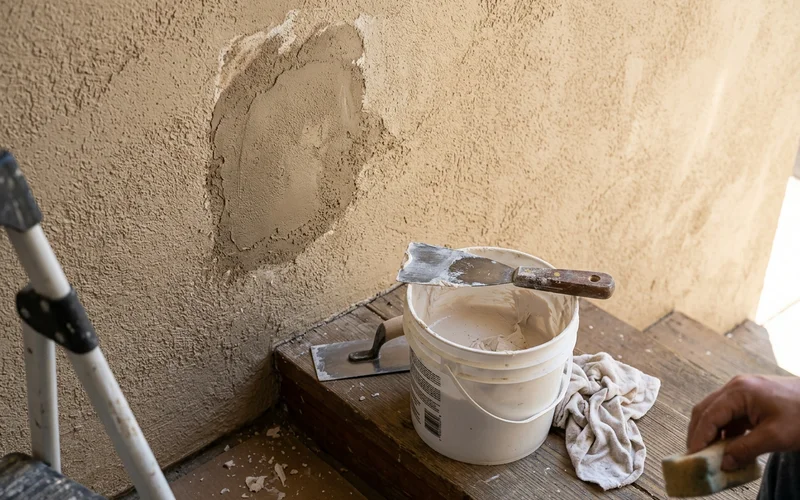
If cracks are wide, run diagonally from window corners, or keep getting bigger, you likely have structural movement from Round Rock’s clay-soil shifts. We always recommend having a specialist inspect the foundation before spending thousands of dollars on coatings. Throwing expensive paint at a failing foundation solves nothing.
Moisture and Breathability
Moisture management is the critical factor when deciding between coatings. Stucco is highly porous, and a healthy wall system must allow trapped water vapor to escape. The industry standard requires a coating with a perm rating of 10 or higher for traditional stucco.
Standard premium acrylic paint provides that breathability (10 to 20 perms). Elastomeric paints have a perm rating below 5. If water gets inside through a bad window seal or roof flashing, a less breathable coating will trap it.
Red flags to look for before specifying elastomeric:
- Signs of active leaks or staining around parapets
- Efflorescence (white salt deposits) showing water moving through the wall
- Sprinklers soaking the base of the walls every morning (common on Round Rock corner lots)
- Poor grade and inadequate drainage around the foundation
Our rule of thumb
Elastomeric is a great choice on sound Round Rock stucco with hairline cracks and no moisture problems. It’s the wrong choice for covering up a wall that’s getting wet from somewhere.
When Standard Acrylic Is the Better Choice in Round Rock
A premium 100% acrylic exterior paint is the best workhorse choice for sound stucco. 2026 pricing data puts standard professional painting at $1.50 to $4.50 per square foot in Round Rock. Elastomeric projects push to the high end of that range or well beyond it.
Opt for 100% acrylic when:
- The stucco has few or no visible cracks
- There are moisture concerns your contractor cannot fully fix
- You want to keep a fine, crisp stucco texture visible
- Budget constraints prioritize a lower initial cost over maximum crack-bridging
Our guide to heat and UV failures explains why premium acrylics still last 7 to 10 years under the Round Rock sun.
A Few Practical Notes
- Color choices can be more limited with some elastomeric products, especially deep shades that absorb Round Rock heat.
- Repainting later over a rubberized film usually means sticking with elastomeric or a compatible acrylic.
- Application takes longer because the crew must build up 10 to 20 mils of material per coat.
- Pinholing is a risk if the contractor rolls too quickly, leaving tiny holes for water to enter.
Round Rock Stucco Scenarios We Commonly See
- Hairline cracks at window and door corners on Siena and Behrens Ranch homes, where structural stress concentrates.
- Map cracking, a fine web of tiny fissures spreading across sun-baked west walls.
- Efflorescence near the ground or below windows, which indicates water is moving through the wall.
- Faded, chalky paint on south and west elevations.
Hairline and map cracking are the best fit for elastomeric. Efflorescence and chalky staining tell us to look for an active water source first.
How Long Does It Take?
Elastomeric projects take longer than a standard Round Rock repaint. Build extra days for crack repair, patch drying, thicker coats and weather sensitivity. We plan around the Round Rock forecast to make sure the rubberized membrane cures flawlessly.
Maintaining an Elastomeric Finish
An elastomeric coating needs very little routine attention once it fully cures.
- Rinse dirt off gently with a garden hose. Avoid high-pressure washers that puncture the seal.
- Redirect lawn sprinklers to keep water off the painted walls.
- Monitor the surface for new cracks wider than a hairline.
Getting the Right Answer for Your Round Rock Walls
The honest answer is that it strictly depends on your specific wall conditions.
Our Bluebonnet Ridge Painting Round Rock crew will check crack sizes, search for hidden moisture sources and talk through your long-term goals before recommending elastomeric or a breathable acrylic. Either way, the necessary crack repair, specific primer and exact product go into your written quote by name.
Call (512) 555-0163 or email demo@locuspilot.com to schedule an on-site consultation within 24 hours anywhere in Williamson County.